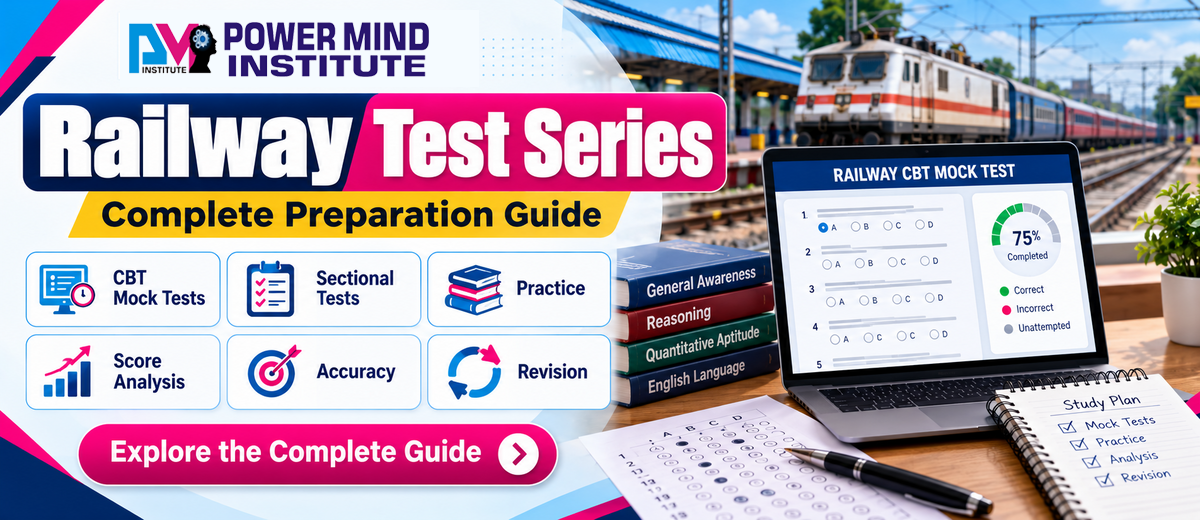
Choose a Railway Test Series that matches the exam and stage you are preparing for. A full mock helps you practise using the clock across a paper. A short test helps you find out why you keep missing questions in one topic. You can use both in the same week, with time set aside to review your answers.
If you are just starting, pick a topic you have studied and take a short test on it. If you already know most of the syllabus, take one full mock and use the result to plan your next study sessions. Here is how to choose the right tests and make the review count.
How to choose a Railway Test Series
Start with the exam name and stage on your application. An RRB NTPC test series should identify which CBT it is for. For ALP, check the stage and, where relevant, the trade or part being tested. For Technician, check the grade. For Group D, look for Level 1 practice. Read the relevant RRB notice before using any mock to copy exam timing or marking.
Open a sample test before you commit. Check that the questions match the topics you need and that the answer explanations show the steps. If you are looking at railway coaching in Jaipur, ask to see how a teacher reviews a wrong answer from a sample paper.
| Test type | Use it when | What to record |
|---|---|---|
| Topic test | You just finished a chapter | The rule or formula you missed |
| Sectional test | You want to practise one subject under time | The questions that took longest |
| Full CBT mock | You need to practise a complete paper | Attempts, accuracy and time by section |
| Retry set | You want to check if a correction stuck | Whether you can solve a fresh example |
What to check before your first full mock
Look at the official notice for your recruitment and compare it with the test instructions. Check the subjects, duration and scoring rules. For a computer based test, practise using a timer and moving between questions when your mock supports it. Follow the official instructions for any exam day rules.
Prepare a rough sheet and decide how you will flag uncertain answers. After you submit, compare the flagged questions with your actual mistakes. A correct guess still deserves a look because you may face a similar question with different options next time.
How to read your Railway CBT mock test result
Start with attempts and correct answers. Suppose you attempted 60 questions and answered 45 correctly. Your accuracy on attempted questions is 45 divided by 60, or 75%. That figure describes your accuracy. Calculate your mock score separately using the marking instructions for the test you took.
Now look at where you spent your time. Perhaps you lost five minutes on one calculation and skipped questions you could solve. For the next mock, practise moving on sooner when you cannot see a way forward. During review, check whether the skipped questions were genuinely within reach.
Compare two attempts to choose your next practice set
Imagine you answered 40 of 50 attempted questions correctly in one mock, then 42 of 60 in a similar mock. You gained two correct answers, but your wrong answers rose from 10 to 18. Check the second paper to see whether those extra errors came from guesses, rushed calculations or unfamiliar topics.
If most errors came from rushed calculations, take a short maths set and leave time to check your working. If they came from one unfamiliar topic, revise that chapter before the next full test. Keep a note of what you changed so you can see whether it helped.
Give each mistake a next step
Group your mistakes into three causes. You may have forgotten a fact or formula, used the wrong method, or misread a detail. For a forgotten formula, write it from memory and check it. For a method error, redo the problem from the first step. For a reading slip, mark the word you missed and practise a similar question.
Use the same routine when working with old papers. The RRB NTPC previous year papers guide shows how to label each paper by stage and turn mistakes into revision tasks. Apply that method to papers from your own exam.
Plan your next week around the result
After a test, pick one or two mistakes you can fix this week. If you got several questions wrong on percentages, revise how to choose the base number. If you lost time on a direction question, sketch the route on paper. Then solve a few related questions with different numbers or wording.
Keep a small set of reliable questions for this follow up. Look for railway study material with worked solutions so you can compare the method and see where your steps differ. A short set you can finish and review fits better into a busy day than a full paper left half checked.
| Session | Suggested task | What to check |
|---|---|---|
| Early week | Revise two topics from your last test | Can you explain the rule without notes? |
| Midweek | Take one sectional test | Did the same error recur? |
| Weekend | Attempt a full mock if you can review it | Where did you lose marks or time? |
| Next session | Retry selected errors and one fresh question | Can you repeat the method on a new problem? |
Adjust this study plan around your classes and work. If you have only twenty minutes, use ten for questions and ten for corrections. Keep a simple record of the date, test name and the one thing you will change next time. Compare tests of similar difficulty and format when you judge progress.
Leave a gap before retrying a question. If you attempt it immediately, you may remember the answer from the explanation. Try it again a day or two later, then solve a fresh question with the same rule. If you can explain both methods, move on to the next weak topic.
Power Mind Institute lists railway classes and practice options. If you are unsure how to review your results, bring a marked question and your rough work to a doubt session. Ask for feedback on the first step you got wrong, then try a similar question yourself.
Frequently asked questions
Q. Should beginners start with a full Railway CBT mock test?
Ans. Start with short topic tests if you are still learning the basics. Add full mocks when you have enough time to review them and can attempt questions across several subjects.
Q. Can I use the same test series for NTPC and Group D?
Ans. Use shared topics for extra practice where they overlap. Choose separate full mocks that match each exam’s official syllabus and format.
Q. How do I choose an ALP or Technician mock?
Ans. Match the ALP stage and any applicable part or trade. For Technician, check the grade. Compare the sample paper with the notice for your recruitment.
Q. How can I tell if my test scores are improving?
Ans. Compare similar tests and look at accuracy, time and repeated mistakes together. A higher score on an easier paper gives limited information about your progress.
Q. How many railway mock tests should I take each week?
Ans. Choose a number you can review properly. A full mock plus a few short sets is a starting option when your schedule and preparation allow it.
Q. Should I record answers I got right by guessing?
Ans. Yes. Mark them separately and try each question again without looking at the options. That will show which topics still need practice.