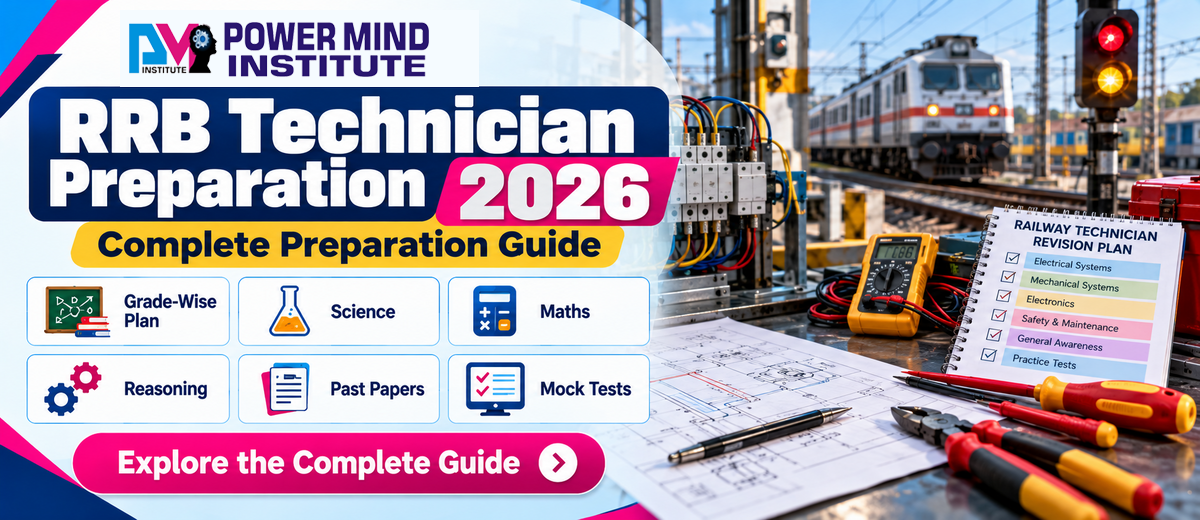
Start your RRB Technician Preparation 2026 by checking your grade. Grade I Signal includes computers and basic engineering, while Grade III covers general science at Class 10 level. Both include maths, reasoning and general awareness, but the maths topics can differ. Make a checklist for your own grade before picking a book or a mock test.
If you have an hour to study today, use part of it on the science topics for your grade and the rest on a short maths or reasoning set. Keep the last few minutes to check mistakes. Once you know where you get stuck, you can plan the rest of your week around those gaps.
RRB Technician Preparation 2026 by grade
The Railway Recruitment Board’s CEN 02/2026 notice (PDF copy), listed on 30 June 2026, sets out separate computer-based tests for the two pay levels. Section 16.1 specifies 100 questions and 90 minutes for each standard test, with a deduction of one third of a mark for a wrong answer. Check notices from your RRB for updates that apply to you.
| Grade | What to study | A useful first step |
|---|---|---|
| Grade I Signal | Maths, reasoning, general awareness, computer basics, and basic science and engineering | Try a short set on circuits and computer hardware |
| Grade III | Maths, reasoning, general awareness, and Class 10 level physics, chemistry and life sciences | Choose one school science chapter and answer questions from memory |
Use the detailed syllabus for your grade as the final checklist. The notice describes its subject-wise question split as indicative, so build a routine that covers every listed subject. If you are comparing railway coaching in Jaipur, ask how classes and practice papers are organised for your grade.
Grade I Signal practice for computers and engineering
For computers, start with what each part does. Group a keyboard and mouse under input, a monitor under output and a drive under storage. Then move to operating systems, basic networks and office applications. After reading, explain one difference aloud, such as how a web browser differs from a search engine.
Work through a circuit before memorising formulas
Draw a simple circuit with a 12 volt supply and a 6 ohm resistor. Using Ohm’s law, divide 12 by 6 to get 2 amperes. Next, put two 6 ohm resistors in series. The total resistance is 12 ohms, so the current with the same supply falls to 1 ampere. Label every value with its unit.
Apply the same habit to electronics and measurement topics. Draw the setup, name the quantity being measured and explain what changes when you change one part. When looking at railway preparation books, check that the examples include diagrams and steps you can follow on your own.
Explore Railway Study Material
Grade III practice for general science
Rotate between physics, chemistry and life sciences. For physics, try a small set on motion or electricity. For chemistry, practise identifying acids and bases or balancing simple equations. For life sciences, draw a process such as digestion and label what happens at each step.
Check whether you can explain a concept without your notes. For example, a plant needs light energy to make sugars during photosynthesis. Once you can explain the idea in plain language, try a question that asks what might happen if the plant receives less light. This tests understanding beyond the definition.
Keep a page for pairs you confuse, such as mass and weight or acids and bases. Write one difference and one example for each pair. For a practical way to turn wrong answers into study tasks, see the railway paper review method in our NTPC guide. Use Technician papers for your actual practice.
Give maths and reasoning separate practice time
Match your maths questions to your grade. Grade I Signal candidates can practise sets, basic probability and geometry. Grade III candidates can start with fractions, percentages and time and work. In reasoning, begin with a short set on directions or number series, then explain the steps that lead to each answer.
If you miss a question, try it again before reading the solution. For maths, check which number you used as the base of a percentage. For directions, redraw the route and mark north. Keep general awareness in the routine too. Review a small set of notes and check dated facts against the original source.
A weekly RRB Technician study plan
Use the plan below as a starting point and adjust it to your timetable. The sessions are suggestions. Before taking a full RRB Technician mock test, confirm that it matches the grade and format in your notice.
| When | Practice task | Check before moving on |
|---|---|---|
| Days 1 and 2 | Study a science or engineering topic and answer a short set | Can you explain the rule without notes? |
| Days 3 and 4 | Work on maths and reasoning, with a short awareness review | Which mistakes keep coming back? |
| Day 5 | Try a timed set for your grade | Which questions slowed you down? |
| Days 6 and 7 | Review errors and retry a few similar questions | Can you solve a fresh example? |
Keep three numbers after each test: attempts, correct answers and time spent. If you can solve a skipped question without a timer, practise speed on similar questions. If the method is still unclear, return to the chapter. Pick two mistakes to fix before your next test.
How to use RRB Technician previous year papers
Write the grade and year at the top of your practice sheet. Solve questions from a topic you have already studied before trying a complete paper. When you review, circle any answer you guessed, even if it was correct. Then check whether you can explain the steps without looking at the key.
For the next session, pick one error you can fix. If you mixed up current and voltage, draw a new circuit and label both quantities. Save a fresh question for the end to check whether the lesson has stuck.
Getting help with your weak topics
Power Mind Institute lists railway classes and test practice. If a chapter keeps holding you back, bring one question and your rough work to a doubt session. Ask the teacher to explain the first step you missed, then try a similar question yourself.
Before choosing a batch, check which grade it covers and whether you can review test solutions in a language you understand. A demo class can help you judge the pace and see how the teacher explains a topic you find difficult.
Frequently asked questions
Q. Do Grade I Signal and Grade III use the same paper?
Ans. CEN 02/2026 provides a separate CBT for each pay level. Choose practice sets for the grade you applied for.
Q. Which science topics should Grade III students study?
Ans. Cover physics, chemistry and life sciences at Class 10 level. Use chapter questions and short tests to check your understanding.
Q. What should I study first for Grade I Signal?
Ans. Start with simple circuits and computer basics, then add maths, reasoning and general awareness throughout the week.
Q. Can I use previous year papers for both grades?
Ans. Use a paper from your grade for timed practice. For extra topic practice, use questions from another paper only where the syllabuses overlap.
Q. When should I take a full Technician mock test?
Ans. Start with short tests while you learn the basics. Add full mocks once you can solve a mix of topics and have time to review your answers.
Q. How do I use the negative marking rule in practice?
Ans. Score wrong answers using the deduction in your notice. Track guesses separately so you can see which attempts cost you marks.