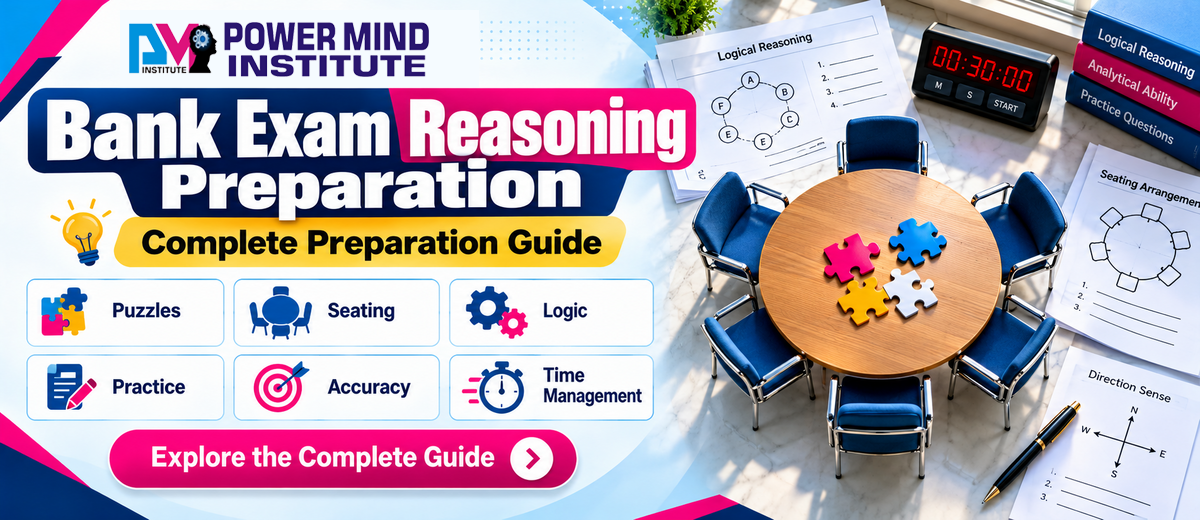
Bank reasoning questions ask you to solve a problem using the information given. You may have to find who sits next to someone, put events in order, compare numbers or work out a family relationship. Learning how to read these questions is the first step in Bank Exam Reasoning Preparation.
If you are starting bank PO or clerk preparation, begin with small questions before trying long puzzles. You do not need to learn every shortcut at once. This guide shows you what to study, how to solve common questions and how to practise without wasting time.
What should you study first?
Start with directions, blood relations, inequality and syllogism. Inequality means comparing values using signs such as greater than or equal to. Syllogism means reading statements and checking which answer must be true. After these basics, move to seating arrangements and puzzles.
Study one topic at a time. Read a rule, solve a few examples and then try questions yourself. If you need help, compare the lessons and practice offered through bank coaching in Jaipur. Choose a class where you can follow the explanation.
| Topic | What to learn first | Useful practice habit |
|---|---|---|
| Inequality | Compare connected values | Check whether the relation is certain |
| Syllogism | Separate statements from assumptions | Use simple circle diagrams |
| Seating arrangement | Position and facing direction | Draw the seats before placing names |
| Puzzles | Link two or more conditions | Record possible cases separately |
How to solve bank exam puzzles
A puzzle may tell you which day each person travels or which floor each person lives on. Your job is to put all the details together. First, count the people and positions. Draw a simple list or table on your rough sheet.
Example: a three-day puzzle
Riya, Aman and Neha attend classes on Monday, Tuesday and Wednesday, one person each day. Neha attends on Wednesday. Riya attends before Aman. Place Neha first. Only Monday and Tuesday remain, so Riya attends on Monday and Aman on Tuesday.
Notice that “before” does not always mean “just before.” In this example, the remaining days fix the answer. In a bigger puzzle, there may be a gap. Read those words carefully. Choose bank study material with explained answers so you can understand where each placement comes from.
How to solve seating arrangement questions
In a seating question, you work out where people sit. They may sit in a row or around a table. Before placing any names, check how many seats there are and which way the people face. Draw the seats clearly.
Example: three people in a row
A, B and C sit in a row facing north. A sits just left of B. C sits left of A. From your left to right, the order is C, A, B. Read the clues again and check that both fit this order.
If people face south, their left is your right on the page. Mark a direction arrow to avoid confusion. For circular seating, check whether people face the centre or outside. Begin with easier sets where everyone faces the same way, then try mixed directions.
Understand inequality and syllogism with examples
In an inequality question, A > B means A is greater than B. If A > B and B > C, A must also be greater than C. But if A > B and C > B, you cannot tell whether A or C is greater.
In a syllogism question, use only the given statements. Suppose all pens are stationery and some stationery is blue. Can you say all pens are blue? No. The blue stationery could be something else. Draw small circles if this helps you see the groups.
When you understand these basics, try a short test with different topics. Our article on mock tests in bank exam preparation explains why test practice and checking your answers should go together.
Bank Exam Reasoning Preparation: a simple daily plan
You can use the plan below if you have about one hour for reasoning. These times are study suggestions, not official exam timings. If you have less time, shorten each part but still leave a few minutes to check mistakes.
Begin with a topic you studied recently. Then solve a puzzle or seating set. Finish with a short timed test and review. Use questions at a level you can learn from. Trying only very hard questions can leave you with little time to understand the answers.
| Practice block | Suggested time | Task |
|---|---|---|
| Basics | 15 minutes | Revise one rule and solve short questions |
| Arrangements | 20 minutes | Solve two sets and check every clue |
| Timed practice | 15 minutes | Attempt a mixed reasoning set |
| Review | 10 minutes | Redo errors without seeing the solution |
Keep a small record of how many questions you tried, how many were correct and how long you took. Compare your results each week. Getting more answers right is useful progress, even when your speed improves slowly.
What should you do after a wrong answer?
Find the first step where you went wrong. Did you miss a clue, confuse left and right or add a detail that was not given? Write one short note about it. Then solve the question again without looking at the answer.
For example, write “before does not mean immediately before” if that caused the mistake. The next day, try another question using that rule. This helps you learn the method instead of remembering one answer.
Once a week, mix easy and harder questions. Start with the ones you understand, then return to the others. This helps you practise choosing questions as well as solving them.
How Power Mind Institute can help students
Power Mind Institute offers classroom and online learning options, study material, tests and doubt support on its website. These can help you follow a routine: learn a topic, practise questions, check mistakes and ask for help where needed.
For reasoning, a helpful teacher should explain each step on the rough sheet. If you keep getting seating questions wrong, show your drawing and ask where you made the first mistake. Understanding that step is more useful than copying a finished answer.
Before joining, ask about the class language, batch level, timings and doubt sessions. Check whether the lessons start from basics. A demo class can help you see whether you understand the teacher and feel comfortable asking questions.
Frequently asked questions
Q. How should I start Bank Exam Reasoning Preparation?
Ans. Start with directions, blood relations, inequality and syllogism. Learn the rules and practise short questions before moving to longer puzzles.
Q. Why do I get seating arrangement answers wrong?
Ans. Check facing directions and words such as “immediately.” One wrong placement can affect the whole set. Read every clue again after finishing.
Q. Should I use a timer from the first day?
Ans. First learn how to solve the questions correctly. Add a timer once you understand the steps, then work on speed gradually.
Q. How many puzzles should I practise daily?
Ans. Start with one or two sets you can review properly. Increase practice when you can solve them correctly without needing the explanation.
Q. Is reasoning preparation the same for PO and clerk exams?
Ans. Many basic skills are shared. Choose practice for your own exam and stage, and check its official notice for the test details.
Q. What should I do if a puzzle takes too long?
Ans. During practice, check which clue stopped you. During a test, try another question and return later if the test rules allow it.