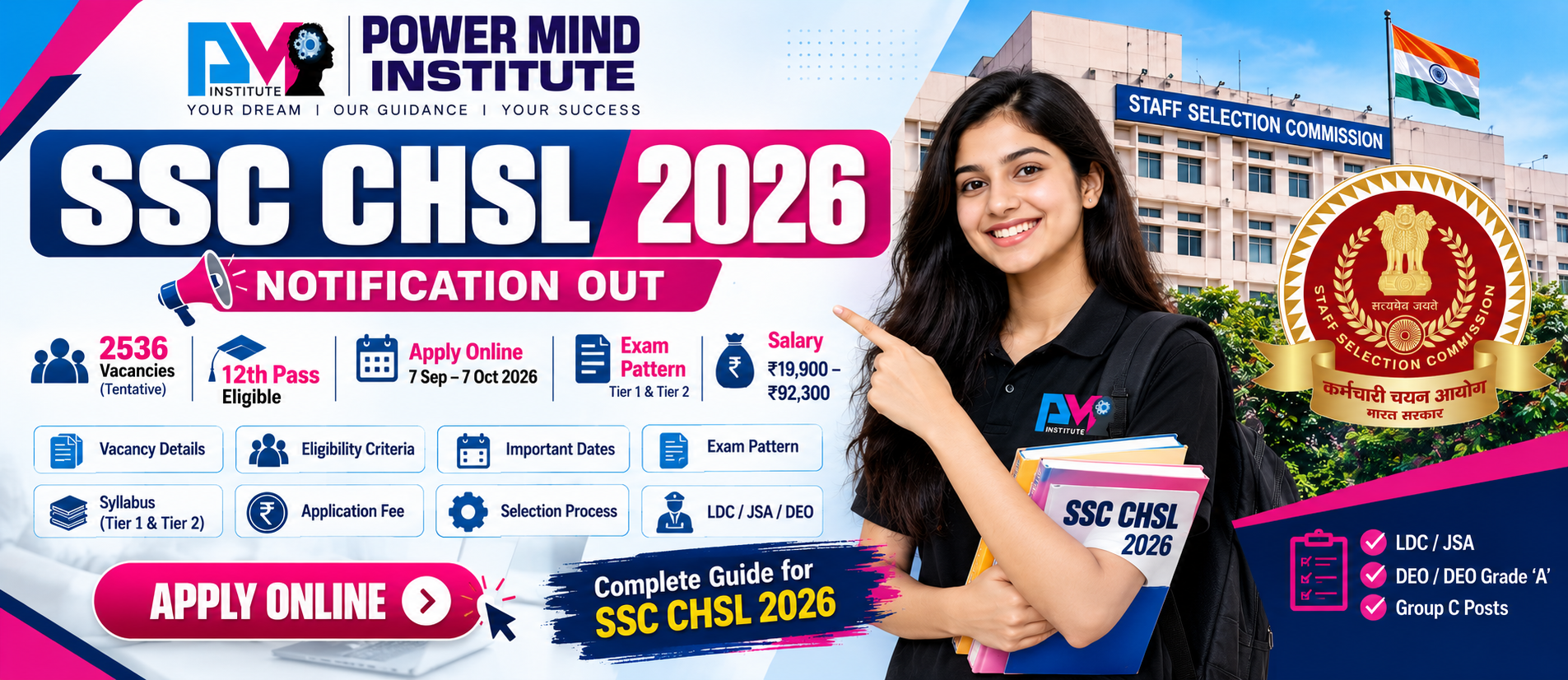
SSC CHSL is one of the most popular government examinations for students who have completed Class 12. Every year, a large number of aspirants compete for posts such as LDC, JSA, Postal Assistant, Sorting Assistant, and DEO. With strong competition, starting preparation without a proper plan can make the syllabus feel overwhelming.
For beginners, the right approach is to understand the examination structure first and then divide preparation subject by subject. A practical SSC CHSL 2026 Preparation Strategy should include concept building, regular question practice, revision, previous year papers, and mock tests. Preparing consistently from the beginning can help students improve accuracy and speed before the actual examination.
Understand the SSC CHSL Syllabus and Exam Structure
Before opening your books, spend some time understanding the SSC CHSL Syllabus 2026. Knowing the subjects and major topics helps you decide how much time each section needs. It also prevents you from spending too much time on low-priority areas.
The current examination structure includes Tier 1 and Tier 2. Tier 1 covers English Language, General Intelligence, Quantitative Aptitude, and General Awareness. Tier 2 includes Mathematical Abilities, Reasoning and General Intelligence, English Language and Comprehension, General Awareness, Computer Knowledge, and a Skill or Typing Test where applicable.
Set Realistic Daily Study Hours
Students do not need to study for ten or twelve hours every day to make progress. A consistent schedule of focused study is more useful than long hours without proper revision.
If you are starting from zero, begin with manageable study sessions and gradually increase practice time. Keep separate slots for learning concepts, solving questions, revision, and testing yourself.
SSC CHSL Subject Wise Preparation Strategy
A good SSC CHSL Subject Wise Preparation plan should give attention to every section. Ignoring one subject because it feels difficult can create problems later, particularly when you start attempting full-length tests.
Divide your preparation into small topic groups. Finish the basics first, then move towards timed practice. This approach makes the syllabus easier to manage and gives you a clear idea of your progress.
Quantitative Aptitude
Mathematics can become a scoring section when your fundamentals are strong. Start with basic arithmetic concepts before moving to more complex questions.
Important areas can include percentage, ratio and proportion, average, profit and loss, interest, time and work, speed and distance, number systems, and other arithmetic topics. Regular calculation practice is important because students need both accuracy and speed.
Maintain a small formula notebook and revise it frequently. After learning a concept, solve different question types instead of repeatedly solving questions with the same pattern.
English Language
English requires consistent practice rather than occasional study. Start with grammar fundamentals and gradually improve vocabulary and reading ability.
Focus on areas such as error detection, sentence improvement, synonyms, antonyms, idioms, one-word substitutions, comprehension, and grammar-based questions. Reading regularly can also improve understanding and vocabulary.
Try to learn new words through examples instead of memorising long lists. This makes vocabulary easier to remember and apply during the examination.
General Intelligence and Reasoning
Reasoning can improve considerably through regular question practice. Begin with simpler topics and focus on understanding the logic behind each question.
Topics such as analogy, classification, series, coding-decoding, directions, blood relations, and non-verbal reasoning should be included in your practice routine. Once you become comfortable, start solving questions with a time limit.
Keep track of questions that take too long. Your goal should not only be to find the correct answer but also to reach it efficiently.
General Awareness
General Awareness requires a different approach because its syllabus is broad. Instead of trying to memorise everything at once, divide the preparation into static subjects and current affairs.
Give regular attention to History, Geography, Polity, Economy, Science, and important national and international developments. Make short revision notes and revisit them frequently.
Daily revision is particularly important for this section because information can be easily forgotten when you study it only once.
SSC CHSL Study Plan for Beginners
A practical SSC CHSL Study Plan 2026 should balance all subjects instead of dedicating several days to only one section.
A beginner can structure a daily routine like this:
- 2 hours for Mathematics
- 1.5 hours for English
- 1.5 hours for Reasoning
- 1 hour for General Awareness
- 30 minutes for revision
- 30 minutes for previous year questions or a sectional test
You can adjust these timings according to your strengths and weaknesses. Students who are weak in Mathematics may dedicate additional practice time to it, while stronger students can use that time for revision and testing.
Follow a Three-Phase Preparation Plan
Divide your preparation into three phases. The first phase should focus on completing basic concepts and understanding the syllabus.
The second phase should increase question practice and previous year paper solving. In the final phase, focus more heavily on mock tests, revision, time management, and correcting repeated mistakes. Similar phased strategies are commonly recommended for comprehensive CHSL preparation.
Use Previous Year Papers and Mock Tests
One of the most important SSC CHSL Preparation Tips is to solve previous year papers regularly. They help you understand question styles, recurring concepts, difficulty levels, and the amount of time required for different sections.
Do not wait until you complete the entire syllabus before attempting tests. Start with sectional tests and gradually move towards complete papers. This allows you to identify weak areas while there is still enough time to improve.
Make Mock Test Analysis Part of Your Routine
An SSC CHSL Mock Test 2026 is useful only when you analyse your performance after completing it. Simply checking your score does not tell you why marks were lost.
After every test, divide your mistakes into three categories:
- Conceptual mistakes
- Calculation or comprehension mistakes
- Time-management mistakes
Then revise the relevant topic and attempt similar questions again. This creates a continuous improvement cycle.
How to Improve Speed and Accuracy
Speed becomes important when you are comfortable with the concepts. Trying to solve questions quickly without understanding them can increase mistakes.
Start by solving questions without a strict time limit. Once accuracy becomes consistent, introduce short time limits. Gradually reduce the time required while maintaining your accuracy.
Avoid spending too much time on a single difficult question. During mock tests, learn to identify questions that can be solved quickly and return to lengthy questions later.
Common Mistakes Beginners Should Avoid
Students following an SSC CHSL Preparation for Beginners approach often make a few common mistakes. The biggest one is trying to complete too many resources at once.
Avoid these habits:
- Changing study material repeatedly
- Ignoring weak subjects
- Skipping revision
- Taking too few mock tests
- Memorising without understanding
- Ignoring previous year papers
- Studying without tracking progress
Choose reliable resources and stay consistent with them. Your preparation should become deeper over time rather than wider and more confusing.
How to Prepare With Power Mind Institute
Students who find it difficult to maintain consistency through self-study can consider structured guidance. A coaching environment can provide a fixed routine, subject-wise teaching, regular practice, test-based evaluation, and guidance when difficult concepts create confusion.
For students looking for best SSC CHSL Coaching in Jaipur, the right institute should be evaluated based on faculty experience, study material, mock tests, doubt support, classroom environment, and preparation methodology. Before joining, attend a demo class where possible and understand exactly what the course provides.
With structured classes, regular practice, revision, and exam-focused guidance, Power Mind Institute can help students build a disciplined preparation routine for SSC CHSL. Students can explore its SSC preparation programs and choose a learning approach that fits their preparation level and examination goals.
Conclusion
A successful SSC Exams Preparation Strategy does not depend on studying everything in a single month. It depends on consistent progress, strong fundamentals, regular practice, and honest analysis of your performance. Start by understanding the syllabus, create a realistic routine, strengthen each subject, and gradually increase your mock-test practice.
For beginners, the most important step is to start with a clear plan and stay consistent. If you regularly revise what you learn, solve previous year questions, analyse your mistakes, and work on speed and accuracy, your preparation can become much more effective and exam-focused.