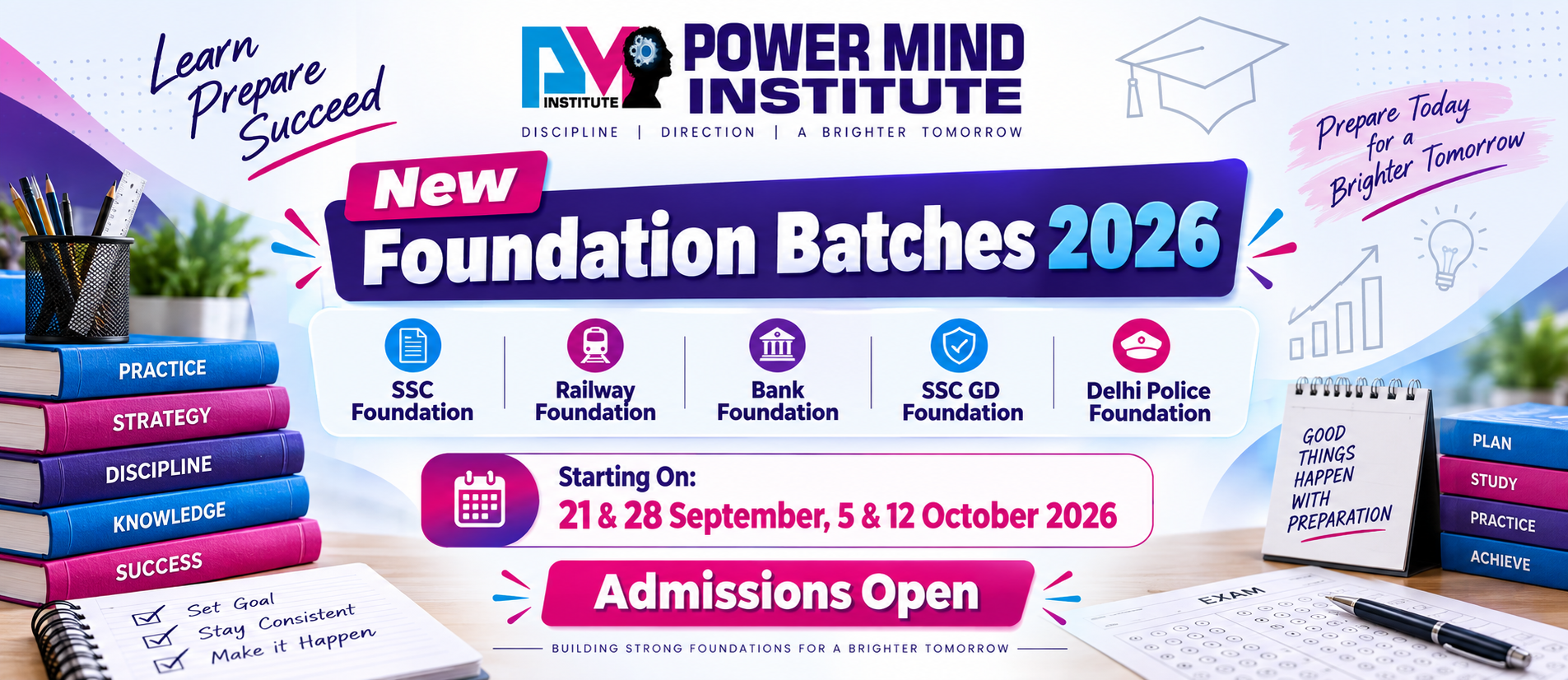
Admissions are now open for Government Exam Coaching 2026 foundation batches in Jaipur. Aiming for SSC, Railway, Bank, SSC GD or Delhi Police in the 2026 cycle? A September–October start gives you enough runway to build concepts, speed and test temperament under a structured plan.
Use this guide to choose your stream, pick the right batch type, and map your study months to the likely 2026 exam windows. It’s for serious aspirants weighing a Government Exam Foundation Course against self-study, especially anyone seeking Competitive Exam Coaching in Jaipur with both classroom and online options.
Admission Window: September–October 2026 Foundation Batches
For the Sep–Oct intake, fresh enrollments open across five tracks—SSC Foundation Batch 2026, Railway Foundation Batch 2026, Bank Foundation Batch 2026, SSC GD Foundation Batch 2026 and Delhi Police Foundation Batch 2026. Seats are allotted on a first-confirmed basis once counseling is complete.
Choose weekday, weekend or evening timings in classroom (Jaipur) or live online. If you’re unsure which stream suits you, join the academic counseling for foundation courses at Power Mind Institute, where your prior attempts and target posts are matched to a study path.
Who Should Join These Foundation Courses in 2026
These new Government Exam Batch 2026 options make sense if you’re starting from basics, coming back after a gap, or switching streams. Final-year students can start early so they’re exam-ready when official calendars release. School pass-outs targeting constable-level roles get a longer runway for fundamentals.
Jaipur-based aspirants who want classroom rigour should consider SSC coaching in Jaipur for Tier-1/Tier-2 readiness, while working professionals may prefer weekend or online batches. Candidates with state domicile in Rajasthan should still verify central vs state quotas and any relaxation rules in the official notifications.
What You’ll Study: Subject-Wise Plan for SSC, Railway, Bank, SSC GD & Delhi Police
SSC stream (CGL/CHSL/MTS/CPO/JE basics)
In the early months, classes build number systems, arithmetic (percentages, ratio, CI-SI, time-speed-distance, time-work), algebra, geometry and mensuration, reasoning varieties, vocabulary and grammar, along with Static GK and polity-history-economy. Past-year SSC papers decide the class order so difficulty mirrors the real exam. Non-engineers aiming JE cover exam awareness and the common sections only; core JE technical needs a separate plan.
Banking stream (IBPS, SBI, RRB)
Bank batches push calculation speed, Vedic techniques, high-level puzzles (floor, box, distribution), seating arrangements, data interpretation, number series, inequality, syllogism, reading comprehension and cloze. Sectional timing is trained from day one. If you need a local hybrid option, explore bank coaching in Jaipur with live-lecture backups and regular proctored mocks.
Talk to a Power Mind Institute Counsellor →
Railway stream (RRB NTPC, Group D, ALP/Technician basics)
Expect quant basics tuned to RRB styles, logical reasoning, general science (Physics, Chemistry, Biology at 10th–12th level) and Railway-specific Current Affairs. ALP/Technician aspirants meet CBT-2 aptitude early, then branch to technical later. Classroom learners wanting city access can opt for railway coaching in Jaipur with lab-like CBT practice.
SSC GD & Delhi Police stream
The foundation builds arithmetic basics, reasoning patterns common in GD/Constable, English/Hindi fundamentals, Current Affairs and Computer awareness as per recent papers. Separate guidance covers PET/PMT awareness and documentation. For hands-on police exam orientation, consider Delhi Police coaching in Jaipur once your written prep hits steady scores in mocks.
Weekly Schedule, Class Format and Test Series
Most foundation batches run 5–6 days a week for 2–3 hours per day. Working aspirants can move to weekend tracks with longer sessions. Each topic cycle ends with a short quiz; a weekly combined test checks retention across subjects, and monthly full-length mocks benchmark you against your target exam’s pattern. Doubt counters operate on fixed slots.
Study material is updated to reflect new question types, especially in puzzles/DI for banking and arithmetic-mix MCQs for SSC and RRB. Printed notes, home assignments and past-year sets keep you anchored. Online learners get live classes with recordings, plus proctored online tests that simulate the CBT environment.
Classroom in Jaipur vs Live Online
Pick classroom if you thrive on in-person pace control, board work and peer competition. Go online if commute is a problem or you need flexible timings with recordings. Either route gives you a common test series and mentor check-ins so your progress stays measurable against Government Exam Coaching 2026 goals.
How to Prepare Month-by-Month Till Your 2026 Exams
In Sep–Oct, lay foundations—concept-first classes, basic calculations, vocabulary building and NCF-based GS refresh for RRB/SSC. Take one mock every two weeks. If you’re changing streams (say, from SSC to Bank), keep the second stream as a light backup only.
Through Nov–Jan, increase volume—two subjects daily, sectional drills under time, and weekly mixed-topic tests. SSC track adds advanced algebra/geometry and Static GK capsules; Bank raises puzzle/DI difficulty; RRB deepens Science and railway awareness. Start revising short notes and error logs nightly.
By Feb–Mar, transition to full-length mocks—2–3 per week for Bank; 1–2 per week for SSC/RRB depending on accuracy. Analyse every mock for accuracy by topic, average time per question, and negative-marking loss. Push vocabulary and current affairs daily.
From Apr–Jun, align to official calendars. Historically, SSC releases annual calendars and IBPS issues exam notifications on fixed cycles, but dates can shift—always confirm on the SSC, IBPS, RRB and Delhi Police portals. Fine-tune strengths for your main target and keep the secondary only if your scores justify it.
Official Notifications to Track
- Track the SSC Calendar for CGL, CHSL, MTS, GD, CPO and JE timelines, and verify age, attempts and qualification clauses.
- For IBPS/SBI, note the PO and Clerk prelims/mains windows and watch sectional timing and language criteria.
- Follow RRB updates on NTPC, Group D and ALP/Technician CBTs, checking regional RRB websites for notices.
- For Delhi Police Constable/SI, confirm PET/PMT and document rules well before the admit card stage.
Common Mistakes Jaipur Aspirants Make and How to Avoid Them
- Don’t study without a primary target—pick SSC, Bank or RRB as your core, and keep others as backups only after you cross safe mock cutoffs.
- Skipping basics hurts more than it helps; weak number sense and grammar leak marks, so use foundation months to build habits, not just coverage.
- Reading theory alone won’t do; end every concept day with 30–40 timed questions, and treat weekly mixed tests as non-negotiable.
- Never ignore official notices since policies change; always check the latest PDF before assuming eligibility or pattern.
- Don’t skip a city-specific plan—if you want Competitive Exam Coaching in Jaipur, lock your commute-friendly slot early so attendance stays consistent.
Why Power Mind Institute Is Best for Government Exam Coaching 2026
Faculty teams are stream-specific—SSC mentors handle higher arithmetic, geometry and Static GK; Bank trainers specialise in high-level puzzles/DI; RRB instructors integrate GS and CBT nuances; police exam coaches guide PET/PMT awareness. This division keeps classes focused on the questions you’ll actually face.
Study material is exam-wise, updated with recent shifts like SSC’s arithmetic mix and banking’s evolving puzzle sets. A layered test ecosystem—topic quizzes, weekly combined tests, monthly full-lengths and open tests—lets you track both accuracy and speed. Doubt counters and mentor reviews are scheduled so backlogs don’t pile up.
Both classroom batches in Jaipur and live online batches are available, with recording access for revision. If you’re targeting a specific stream, you can pair the core batch with a dedicated support track such as SSC coaching in Jaipur, bank coaching in Jaipur, railway coaching in Jaipur or Delhi Police coaching in Jaipur for deeper practice without spreading yourself thin.
New learners can start from basics through foundation courses at Power Mind Institute, then move to intensive test series as exam windows near. The aim is simple: teach you to attempt smartly, reduce negative marking and maintain mock-to-exam consistency.
Conclusion
If your goal is Government Exam Coaching 2026, starting with a September–October foundation batch gives you time to learn thoroughly and test wisely. Map your main target first, then choose the batch mode that keeps you consistent week after week.
Power Mind Institute offers both classroom and online paths in Jaipur; verify eligibility and dates on official portals, lock your batch, and begin the routine that takes you from concepts to confident attempts.
Frequently Asked Questions
Q1. Which exams are covered under the 2026 Foundation Batches?
Ans: The Sep–Oct intake is designed for SSC (CGL, CHSL, MTS, GD, CPO basics, JE basics), Banking (IBPS/SBI/RRB PO & Clerk), Railway (RRB NTPC, Group D, ALP/Technician basics) and Delhi Police (Constable/SI fundamentals). Streams are taught separately with shared fundamentals for Quant, Reasoning and English, and targeted modules for GK/Current Affairs, Computer and exam-specific skills.
Q2. I’m a final-year student/12th pass. Which batch should I choose for 2026?
Ans: Final-year graduates aiming at SSC CGL/Bank PO should pick the SSC or Bank Foundation track. Class 12th pass candidates targeting SSC GD or Delhi Police Constable should join the respective Foundation Batch. Working aspirants can opt for weekend/evening batches. Always verify post-wise age and education criteria in the latest SSC, IBPS, RRB or Delhi Police notifications.
Q3. Can I prepare for SSC and Bank together in a Foundation Course?
Ans: You can build a common base for Quant, Reasoning and English together, but higher stages diverge. SSC needs Static GK and advanced arithmetic/algebra, while Bank demands high-speed calculation, puzzles/DI and sectional timing practice. Most students keep one primary target (SSC or Bank) and use the other as a secondary option after the foundation months.
Q4. How many tests are included and how often are classes held?
Ans: Foundation batches typically run 5–6 days a week with 2–3 hours per session, plus weekend revision for working aspirants. Topic tests are scheduled weekly, and full-length mocks are held monthly in the early phase and more frequently closer to exam cycles. Doubt counters and remedial classes support learners who need extra practice on weak areas.
Q5. What’s the admission process for the Sep–Oct Foundation Batches?
Ans: Seats are limited per batch. Shortlist your stream (SSC, Bank, Railway, SSC GD or Delhi Police), choose classroom in Jaipur or live online, and complete counseling and documentation. Keep your ID proof, academic details and passport photo ready. Fee modes typically include online and in-person payments. Confirm exact dates and batch codes with the institute office before paying.